If limx→0f(x)=0, then limx→0(sin⁡(f(x))f(x))=1.\text{If } \lim_{x \to 0} f(x) = 0, \text{ then } \lim_{x \to 0} \left( \frac{\sin(f(x))}{f(x)} \right) = 1.

Triangle inequality

|x+y|≤|x|+|y|.|x + y| \le |x| + |y|.

||x|−|y||≤|x−y|\Big| |x| - |y| \Big| \leq |x - y|

For large x, factorial > exponential > polynomial > ln/lg.

For any p>0,ε>0,limx→+∞x!xx=0,limx→+∞eεxx!=0,limx→+∞xpeεx=0,andlimx→+∞(ln⁡x)pxε=0.\begin{aligned} \text{For any } p > 0, \, \varepsilon > 0, \quad \\ \lim_{x \to +\infty} \frac{x!}{x^x} = 0, \quad \\ \lim_{x \to +\infty} \frac{e^{\varepsilon x}}{x!} = 0, \quad \\ \lim_{x \to +\infty} \frac{x^p}{e^{\varepsilon x}} = 0, \quad \\ \text{and} \quad \\ \lim_{x \to +\infty} \frac{(\ln x)^p}{x^{\varepsilon}} = 0. \end{aligned}

Trigo

sin⁡(A±B)=sin⁡Acos⁡B±cos⁡Asin⁡B\sin (A \pm B) = \sin A \cos B \pm \cos A \sin B

cos⁡(A±B)=cos⁡Acos⁡B∓sin⁡Asin⁡B\cos (A \pm B) = \cos A \cos B \mp \sin A \sin B

tan⁡(A±B)=tan⁡A±tan⁡B1∓tan⁡Atan⁡B\tan (A \pm B) = \frac{\tan A \pm \tan B}{1 \mp \tan A \tan B}

sin⁡2A=2sin⁡Acos⁡A\sin 2A = 2 \sin A \cos A

cos⁡2A=2cos⁡2A−1=1−2sin⁡2A\cos 2A = 2 \cos^2 A - 1 = 1 - 2 \sin^2 A

sin⁡2x+cos⁡2x=1\sin^2 x + \cos^2 x = 1

tan⁡2x+1=sec⁡2x\tan^2 x + 1 = \sec^2 x

(a+b+c)2=a2+b2+c2+2ab+2ac+2bc(a + b + c)^2 = a^2 + b^2 + c^2 + 2ab + 2ac + 2bc

ek=limn→∞(1+kn)ne^k = \lim_{n \to \infty}(1 + \frac{k}{n})^n

limn→∞tan⁡−1n=π2\lim_{n \to \infty}\tan^{-1}n = \frac{\pi}{2}

Bounded function

Limit point

a is a limit point of set A if ∀δ>0,∃x∈A such that 0<|x−a|<δ.a \text{ is a limit point of set } A \text{ if }\forall \, \delta > 0, \, \exists \, x \in A \text{ such that } 0 < |x - a| < \delta.

Limit of a function

limx→af(x)=Lif∀ε>0,∃δ>0 such that ∀x∈A,0<|x−a|<δ⟹|f(x)−L|<ε.\begin{aligned} \lim_{x \to a} f(x) = L \\ \quad \text{if} \quad \forall \, \varepsilon > 0, \, \exists \, \delta > 0 \text{ such that } \\ \forall x \in A, \; 0 < |x - a| < \delta \implies |f(x) - L| < \varepsilon. \end{aligned}

limx→∞f(x)=L if ∀ε>0,∃N>0 such that ∀x>N,|f(x)−L|<ε.\lim_{x \to \infty} f(x) = L \text{ if } \forall \, \varepsilon > 0, \, \exists \, N > 0 \text{ such that } \forall x > N, \; |f(x) - L| < \varepsilon.

Limit d.n.e

limx→af(x)=∞ if ∀M>0,∃δ>0 such that ∀x∈A,0<|x−a|<δ⟹f(x)>M.\lim_{x \to a} f(x) = \infty \text{ if } \forall \, M > 0, \, \exists \, \delta > 0 \text{ such that }\forall x \in A, \; 0 < |x - a| < \delta \implies f(x) > M.

limx→∞f(x)=∞ if ∀M>0,∃N>0 such that x>N⟹f(x)>M.\lim_{x \to \infty} f(x) = \infty \text{ if } \forall \, M > 0, \, \exists \, N > 0 \text{ such that } x > N \implies f(x) > M.

Squeeze Theorem

If g(x)≤f(x)≤h(x) for x∈I\{a}, and limx→ag(x)=limx→ah(x)=L, then limx→af(x)=L.\text{If } g(x) \le f(x) \le h(x) \text{ for } x \in I \setminus \{a\},\text{ and } \lim_{x \to a} g(x) = \lim_{x \to a} h(x) = L,\text{ then } \lim_{x \to a} f(x) = L.

limx→af(x)=L⇔limx→a|f(x)−L|=0.\lim_{x \to a} f(x) = L \;\Longleftrightarrow\;\lim_{x \to a} \bigl| f(x) - L \bigr| = 0.

Continuity

f:A→ℝ is continuous at a∈A if ∀ε>0,∃δ>0 such that f : A \to \mathbb{R} \text{ is continuous at } a \in A \text{ if } \forall \, \varepsilon > 0, \, \exists \, \delta > 0 \text{ such that }

∀x∈A,|x−a|<δ⟹|f(x)−f(a)|<ε.\forall x \in A, \; |x - a| < \delta \implies |f(x) - f(a)| < \varepsilon.

f(x) is continuous on a set A⇔∀a∈A,limx→af(x)=f(a).f(x) \text{ is continuous on a set } A \;\Longleftrightarrow\;\forall \, a \in A, \; \lim_{x \to a} f(x) = f(a).

Composition

If limx→ag(x)=L and f∈C(L), then limx→af(g(x))=f(limx→ag(x))=f(L).\text{If } \lim_{x \to a} g(x) = L \text{ and } f \in C(L),\text{ then } \lim_{x \to a} f(g(x)) = f\!\left( \lim_{x \to a} g(x) \right) = f(L).

limx→∞(f)x=limx→∞exln⁡(f)=elimx→∞(x⋅f)\lim_{x \to \infty} (f)^x = \lim_{x \to \infty} e^{x \ln(f)} = e^{\lim_{x \to \infty} (x \cdot f)}

Intermediate Value Theorem

If f(x)∈C([a,b]) and f(a)≠f(b),\text{If } f(x) \in C([a,b]) \text{ and } f(a) \ne f(b),

then ∀y∈(min⁡(f(a),f(b)),max⁡(f(a),f(b))),\text{then } \forall \, y \in \bigl( \min(f(a), f(b)), \max(f(a), f(b)) \bigr),

∃c∈(a,b) such that f(c)=y.\exists \, c \in (a,b) \text{ such that } f(c) = y.

Min/max Theorem

If f(x)∈C([a,b]),\text{If } f(x) \in C([a,b]),

then there exist points xm,xM∈[a,b] such that f(xm)≤f(x)≤f(xM).\text{then there exist points } x_m, x_M \in [a,b] \text{ such that } f(x_m) \le f(x) \le f(x_M).

Functions

Differentiability

f is differentiable at x=a if this limit exists:
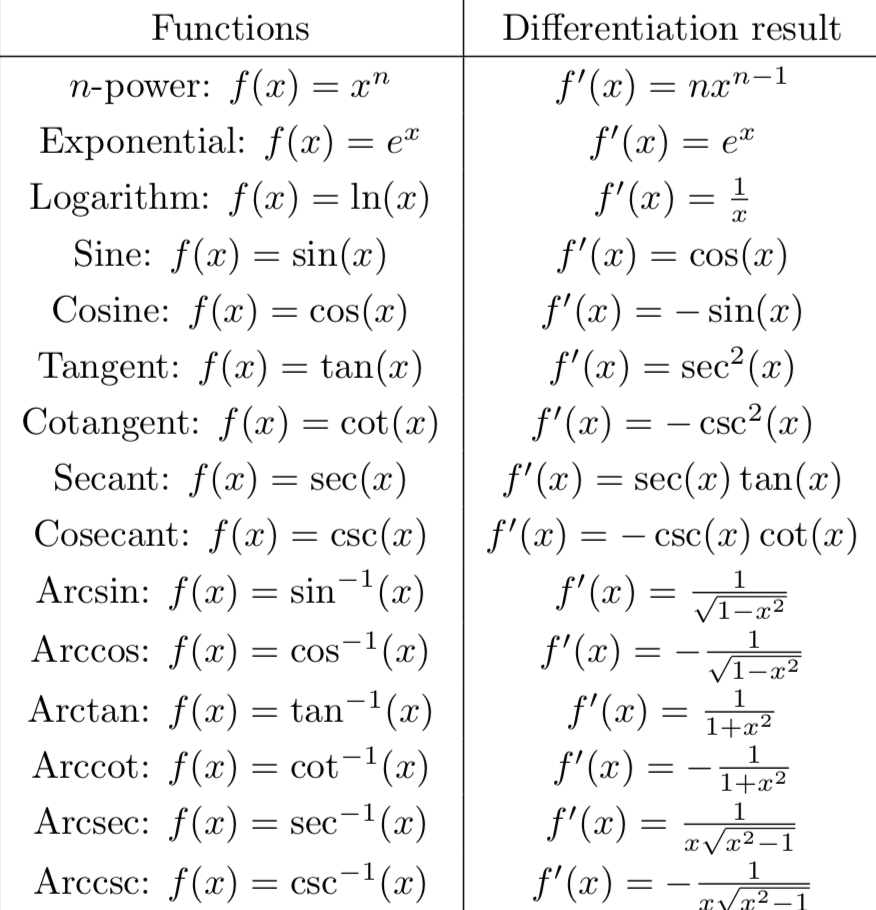
f′(a)=ddxf(x)|x=a=limx→af(x)−f(a)x−a=limh→0f(a+h)−f(a)h.f'(a) = \frac{d}{dx} f(x) \bigg|_{x=a} = \lim_{x \to a} \frac{f(x) - f(a)}{x - a} = \lim_{h \to 0} \frac{f(a + h) - f(a)}{h}.

f′(x)=ddxf(x)=limh→0f(x+h)−f(x)hf'(x) = \frac{d}{dx} f(x) = \lim_{h \to 0} \frac{f(x + h) - f(x)}{h}

D(a)⊂C(a)D(a) \subset C(a)

f∈Cn(A):f(n) exists and is continuous on A.f \in C^n(A) : \; f^{(n)} \text{ exists and is continuous on } A.

Cn(A)⊂Cn−1(A)⊂⋯⊂C1(A)⊂C0(A)C^n(A) \subset C^{n-1}(A) \subset \cdots \subset C^1(A) \subset C^0(A)

Minima/maxima

x0∈A is a global maximum if ∀x∈A,f(x)≤f(x0).x_0 \in A \text{ is a global maximum if } \forall x \in A, \; f(x) \le f(x_0).

f:A→ℝ,x0 is a local maximum if ∃(a,b) such that f : A \to \mathbb{R}, \; x_0 \text{ is a local maximum if } \exists \, (a,b) \text{ such that }

x0∈(a,b) and f(x)≤f(x0) for all x∈(a,b)∩A.x_0 \in (a,b) \text{ and } f(x) \le f(x_0) \text{ for all } x \in (a,b) \cap A.

Mean Value Theorem

If f(x)∈C([a,b]) and f∈D((a,b)),\text{If } f(x) \in C([a,b]) \text{ and } f \in D((a,b)), then there exists c∈(a,b) such that\text{then there exists } c \in (a,b) \text{ such that}

f′(c)=f(b)−f(a)b−a.f'(c) = \frac{f(b) - f(a)}{b - a}.

Rolle’s Theorem

If f(a)=f(b), then there exists c∈(a,b) such that f′(c)=0.\text{If } f(a) = f(b), \text{ then there exists } c \in (a,b) \text{ such that } f'(c) = 0.

Cauchy Mean Value Theorem

If f,g∈C([a,b]) and f,g∈D((a,b)),\text{If } f, g \in C([a,b]) \text{ and } f, g \in D((a,b)),

then there exists some c∈(a,b) such that\text{then there exists some } c \in (a,b) \text{ such that}

f′(c)(g(b)−g(a))=g′(c)(f(b)−f(a))f'(c)\bigl(g(b) - g(a)\bigr) = g'(c)\bigl(f(b) - f(a)\bigr)

Concavity

A function f(x) is concave upward on the interval I if and only if\text{A function } f(x) \text{ is concave upward on the interval } I \text{ if and only if}

for any a<x<b in I,f(x)−f(a)x−a<f(b)−f(a)b−a.\text{for any } a < x < b \text{ in } I, \; \frac{f(x) - f(a)}{x - a} < \frac{f(b) - f(a)}{b - a}.

At an inflection point, f″(x)=0f''(x) = 0 or f″(x)f''(x) does not exist.

However, f″(a)=0⇏af''(a) = 0 \not\Longrightarrow a is an inflection point.

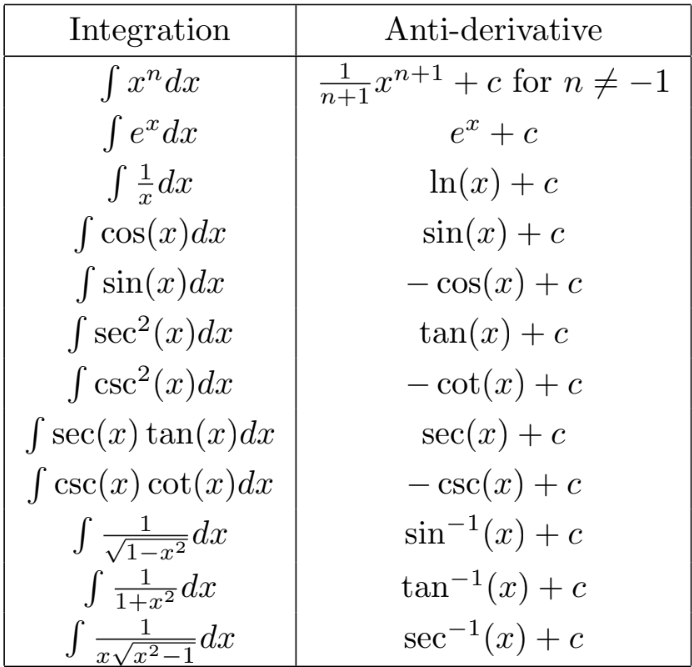
Integration

∫abf(x)dx=limΔx→0∑i=1nf(xi*)Δxi,where Δx=max⁡(Δxi),i=1,2,…,n.\int_a^b f(x) \, dx = \lim_{\Delta x \to 0} \sum_{i=1}^{n} f(x_i^*) \, \Delta x_i, \quad \text{where } \Delta x = \max(\Delta x_i), \; i = 1, 2, \ldots, n.

where xi*∈[ai−1,ai] and a=a0<a1<⋯<an=b.\text{where } x_i^* \in [a_{i-1}, a_i] \text{ and } a = a_0 < a_1 < \cdots < a_n = b.

Choosing n equally spaced points, we get Δxi=b−an=Δx,\text{Choosing } n \text{ equally spaced points, we get } \Delta x_i = \frac{b - a}{n} = \Delta x,

and ∫abf(x)dx=limn→∞b−an∑i=1nf(xi*).\text{and } \int_a^b f(x) \, dx = \lim_{n \to \infty} \frac{b - a}{n} \sum_{i=1}^{n} f(x_i^*).

If f is continuous on [a,b], then it is integrable on [a,b].\text{If } f \text{ is continuous on } [a,b], \text{ then it is integrable on } [a,b].

If f is integrable on [a,b], it is bounded on [a,b],\text{If } f \text{ is integrable on } [a,b], \text{ it is bounded on } [a,b],

and is continuous on [a,b] except at finitely many points.\text{and is continuous on } [a,b] \text{ except at finitely many points.}

|∫abf(x)dx|≤∫ab|f(x)|dx.\left|\int_a^b f(x) \, dx\right| \le \int_a^b |f(x)| \, dx.

favg=1b−a∫abf(x)dxf_{\text{avg}} = \frac{1}{b - a} \int_a^b f(x) \, dx

Integral MVT

If f∈C([a,b]), then there exists c∈[a,b] such that f(c)=favg.\text{If } f \in C([a,b]), \text{ then there exists } c \in [a,b] \text{ such that } f(c) = f_{\text{avg}}.

Integration techniques

∫a+∞f(x)dx=limR→+∞∫aRf(x)dx\int_a^{+\infty} f(x) \, dx = \lim_{R \to +\infty} \int_a^{R} f(x) \, dx

∫fg′dx=fg−∫f′gdx\int f g' \, dx = f g - \int f' g \, dx

Fundamental theorem of calculus

If f∈C([a,b]), let F:[a,b]→ℝ,F(x)=∫axf(t)dt.\text{If } f \in C([a,b]), \text{ let } F : [a,b] \to \mathbb{R}, \; F(x) = \int_a^x f(t) \, dt.

Then for all x∈(a,b),F′(x)=f(x), and F∈C([a,b]).\text{Then for all } x \in (a,b), \; F'(x) = f(x), \text{ and } F \in C([a,b]).

Integration applications

W=∫F(x)dx,for force F and displacement x.W = \int F(x) \, dx, \quad \text{for force } F \text{ and displacement } x.

F=∫pdA,for pressure p and area A.F = \int p \, dA, \quad \text{for pressure } p \text{ and area } A.

M=∫dm=∫ρdV=∫ρA(x)dx,for density ρ and volume V.M = \int dm = \int \rho \, dV = \int \rho A(x) \, dx, \quad \text{for density } \rho \text{ and volume } V.

x‾=∫xdmM=∫xρdVM\bar{x} = \frac{\int x \, dm}{M} = \frac{\int x \rho \, dV}{M}

Differential equations

p(y)y′=q(x)⇒if p,q are continuous, ∫p(y)dy=∫q(x)dxp(y)y' = q(x) \;\Longrightarrow\; \text{if } p, q \text{ are continuous, } \int p(y)\,dy = \int q(x)\,dx

dydx+p(x)y=q(x), Letting P(x)=∫p(x)dx, multiply by eP(x)\frac{dy}{dx} + p(x)y = q(x)\text{, Letting } P(x) = \int p(x)\,dx, \text{ multiply by } e^{P(x)}

Homogeneous linear d.e. with constant coefficients: ay″+by′+cy=0→ar2+br+c=0.\text{Homogeneous linear d.e. with constant coefficients: }a y'' + b y' + c y = 0 \rightarrow a r^2 + b r + c = 0.

y(x)=C1er1x+C2er2x/y(x)=C1er1x+C2xer1x/y(x)=eαx(C1cos⁡(ωx)+C2sin⁡(ωx)).y(x) = C_1 e^{r_1 x} + C_2 e^{r_2 x} \ / \ y(x) = C_1 e^{r_1 x} + C_2 x e^{r_1 x} \ / \ y(x) = e^{\alpha x}\big(C_1\cos(\omega x) + C_2\sin(\omega x)\big).

Judicious guessing of solution to y″+ay′+by=F(x)\text{Judicious guessing of solution to } y'' + a y' + b y = F(x)

Series

With a sequence {ak}k=1∞, we can form the nth partial sum Sn=∑k=1nak=a1+a2+⋯+an.\text{With a sequence } \{a_k\}_{k=1}^{\infty},\text{ we can form the } n\text{th partial sum }S_n = \sum_{k=1}^{n} a_k = a_1 + a_2 + \cdots + a_n.

If limn→∞Sn exists, the series ∑k=1∞ak converges.\text{If } \lim_{n \to \infty} S_n \text{ exists, the series } \sum_{k=1}^{\infty} a_k \text{ converges.}

∑k=1∞(Aak+Bbk)=A∑k=1∞ak+B∑k=1∞bk, if both series converge.\sum_{k=1}^{\infty} (A a_k + B b_k)= A \sum_{k=1}^{\infty} a_k+ B \sum_{k=1}^{\infty} b_k \text{, if both series converge.}

Convergence Tests

Limit Test

Contrapositive: If an↛0, then the series ∑n=1∞an does not converge.\text{Contrapositive: If } a_n \not\to 0, \text{ then the series } \sum_{n=1}^{\infty} a_n \text{ does not converge.}

Integral Test

If f:[1,∞)→ℝ is continuous, decreasing, and limx→+∞f(x)=0, then\text{If } f:[1,\infty)\to\mathbb{R} \text{ is continuous, decreasing, and } \lim_{x\to +\infty} f(x)=0,\text{ then}

∑k=1∞f(k) converges ⇔∫1+∞f(x)dx converges.\sum_{k=1}^{\infty} f(k) \text{ converges } \Leftrightarrow \ \int_{1}^{+\infty} f(x)\,dx \text{ converges.}

P-series

∑n=1∞1np converges ⇔p>1.\sum_{n=1}^{\infty} \frac{1}{n^p} \text{ converges } \Leftrightarrow \ p > 1.

LCT

For an≥0,bn>0 for all n,if limn→∞anbn=L,where L>0,L∈ℝ,\text{For } a_n \ge 0,\, b_n > 0 \text{ for all } n,\ \text{if } \lim_{n \to \infty} \frac{a_n}{b_n} = L,\ \text{where } L > 0,\ L \in \mathbb{R},

then ∑n=1∞an and ∑n=1∞bn either both converge or both diverge.\text{then } \sum_{n=1}^{\infty} a_n \text{ and } \sum_{n=1}^{\infty} b_n \text{ either both converge or both diverge.}

Ratio Test

For an>0 for large n, and limn→∞|an+1an|=c,\text{For } a_n > 0 \text{ for large } n, \text{ and } \lim_{n \to \infty} \left| \frac{a_{n+1}}{a_n} \right| = c,

if c>1, then ∑an diverges.\text{if } c > 1, \text{ then } \sum a_n \text{ diverges.}

if c<1, then ∑an converges.\text{if } c < 1, \text{ then } \sum a_n \text{ converges.}

if c=1, gives no information.\text{if } c = 1, \text{ gives no information.}

Root Test

For an≥0 for large n, and limn→∞ann=c,\text{For } a_n \ge 0 \text{ for large } n, \text{ and } \lim_{n \to \infty} \sqrt[n]{a_n} = c,

if c>1, then ∑an diverges.\text{if } c > 1, \text{ then } \sum a_n \text{ diverges.}

if c<1, then ∑an converges.\text{if } c < 1, \text{ then } \sum a_n \text{ converges.}

if c=1, no information can be concluded.\text{if } c = 1, \text{ no information can be concluded.}

Absolute convergence

If ∑n=1∞|an| converges, then ∑n=1∞an converges absolutely.\text{If } \sum_{n=1}^{\infty} |a_n| \text{ converges, then } \sum_{n=1}^{\infty} a_n \text{ converges absolutely.}

If ∑n=1∞an converges absolutely, then it converges.\text{If } \sum_{n=1}^{\infty} a_n \text{ converges absolutely, then it converges.}

Conditional convergence

If ∑n=1∞an converges, but ∑n=1∞|an| does not, then ∑n=1∞an converges conditionally.\text{If } \sum_{n=1}^{\infty} a_n \text{ converges, but } \sum_{n=1}^{\infty} |a_n| \text{ does not, then } \sum_{n=1}^{\infty} a_n \text{ converges conditionally.}

Leibniz’ Test

For an alternating series ±∑n=1∞(−1)n−1bn, where bn>0,\text{For an alternating series } \pm \sum_{n=1}^{\infty} (-1)^{n-1} b_n, \text{ where } b_n > 0,

if b1≥b2≥b3≥…≥0 and limn→∞bn=0,\text{if } b_1 \ge b_2 \ge b_3 \ge \ldots \ge 0 \text{ and } \lim_{n \to \infty} b_n = 0,

then ∑n=1∞(−1)n−1bn converges.\text{then } \sum_{n=1}^{\infty} (-1)^{n-1} b_n \text{ converges.}

Power Series

Power series: ∑n=0∞an(x−c)n=a0+a1(x−c)+a2(x−c)2+…\text{Power series: }\sum_{n=0}^{\infty} a_n (x - c)^n = a_0 + a_1(x - c) + a_2(x - c)^2 + \ldots

Geometric series: 11−x=∑n=0∞xn=1+x+x2+x3+…, for |x|<1\text{Geometric series: } \frac{1}{1 - x} = \sum_{n=0}^{\infty} x^n = 1 + x + x^2 + x^3 + \ldots, \text{ for } |x| < 1

ln⁡(1+x)=∑n=1∞(−1)n−1xnn=x−x22+x33−x44+⋯,x∈(−1,1].\ln(1+x) = \sum_{n=1}^{\infty} (-1)^{n-1}\frac{x^n}{n} = x - \frac{x^2}{2} + \frac{x^3}{3} - \frac{x^4}{4} + \cdots,\quad x \in (-1,1].

−ln⁡(1−x)=∑n=1∞xnn=x+x22+x33+x44+…,x∈[−1,1).-\ln(1 - x) = \sum_{n=1}^{\infty} \frac{x^n}{n} = x + \frac{x^2}{2} + \frac{x^3}{3} + \frac{x^4}{4} + \dots, \quad x \in [-1, 1).

ex=∑n=0∞xnn!=1+x+x22!+x33!+…,x∈(−∞,∞).e^x = \sum_{n=0}^{\infty} \frac{x^n}{n!} = 1 + x + \frac{x^2}{2!} + \frac{x^3}{3!} + \ldots,\quad x \in (-\infty, \infty).

sin⁡x=∑n=0∞(−1)nx2n+1(2n+1)!=x−x33!+x55!−…,x∈(−∞,∞).\sin x = \sum_{n=0}^{\infty} (-1)^n \frac{x^{2n+1}}{(2n+1)!} = x - \frac{x^3}{3!} + \frac{x^5}{5!} - \ldots,\quad x \in (-\infty, \infty).

cos⁡x=ddx(sin⁡x)=∑n=0∞(−1)nx2n(2n)!=1−x22!+x44!−…,x∈(−∞,∞).\cos x = \frac{d}{dx}(\sin x) = \sum_{n=0}^{\infty} (-1)^n \frac{x^{2n}}{(2n)!} = 1 - \frac{x^2}{2!} + \frac{x^4}{4!} - \ldots,\quad x \in (-\infty, \infty).

tan⁡−1x=∑n=0∞(−1)nx2n+12n+1=x−x33+x55−…,x∈[−1,1].\tan^{-1} x = \sum_{n=0}^{\infty} (-1)^n \frac{x^{2n+1}}{2n+1} = x - \frac{x^3}{3} + \frac{x^5}{5} - \dots, \quad x \in [-1, 1].

Taylor Series

Taylor series: ∑n=0∞f(n)(c)n!(x−c)n=f(c)+f′(c)1!(x−c)+f″(c)2!(x−c)2+…\text{Taylor series: } \sum_{n=0}^{\infty} \frac{f^{(n)}(c)}{n!}(x-c)^n = f(c) + \frac{f'(c)}{1!}(x-c) + \frac{f''(c)}{2!}(x-c)^2 + \ldots

Maclaurin series: ∑n=0∞f(n)(0)n!xn=f(0)+f′(0)x+f″(0)2!x2+f‴(0)3!x3+…\text{Maclaurin series: } \sum_{n=0}^{\infty} \frac{f^{(n)}(0)}{n!}x^{n}= f(0) + f'(0)x + \frac{f''(0)}{2!}x^{2} + \frac{f'''(0)}{3!}x^{3} + \ldots

Ordo

f=𝒪(g) as x→c, if ∃D,δ>0 such that |f|≤D|g|,∀x∈(c−δ,c+δ).f = \mathcal{O}(g) \text{ as } x \to c, \text{ if } \exists\, D, \delta > 0 \text{ such that } |f| \le D|g|, \ \forall\, x \in (c - \delta,\, c + \delta).

For 0≤m≤n,𝒪(xm)+𝒪(xn)=𝒪(xm), as x→0\text{For } 0 \le m \le n,\ \mathcal{O}(x^m) + \mathcal{O}(x^n) = \mathcal{O}(x^m), \text{ as } x \to 0

𝒪(g1)⋅𝒪(g2)=𝒪(g1g2) as x→c.\mathcal{O}(g_1) \cdot \mathcal{O}(g_2) = \mathcal{O}(g_1 g_2) \text{ as } x \to c.

𝒪(g1)g2=𝒪(g1g2) as x→c.\frac{\mathcal{O}(g_1)}{g_2} = \mathcal{O}\!\left(\frac{g_1}{g_2}\right) \text{ as } x \to c.

Taylor’s Theorem with Lagrange remainder

If f is (n+1) times differentiable on an open interval containing c and x, then\text{If } f \text{ is } (n+1) \text{ times differentiable on an open interval containing } c \text{ and } x, \text{ then}

f(x)=Pn(x)+Rn(x)=∑k=0nf(k)(c)k!(x−c)k+f(n+1)(X)(n+1)!(x−c)n+1,f(x) = P_n(x) + R_n(x) = \sum_{k=0}^{n} \frac{f^{(k)}(c)}{k!}(x - c)^k + \frac{f^{(n+1)}(X)}{(n + 1)!}(x - c)^{n + 1},

Taylor’s Theorem, asymptotic version

If f is (n+1) times differentiable on an open interval containing c\text{If } f \text{ is } (n+1) \text{ times differentiable on an open interval containing } c

and f(n+1) is continuous at c,\text{and } f^{(n+1)} \text{ is continuous at } c,

then f(x)=∑k=0nf(k)(c)k!(x−c)k+𝒪((x−c)n+1), as x→c.\text{then } f(x) = \sum_{k=0}^{n} \frac{f^{(k)}(c)}{k!}(x - c)^k + \mathcal{O}\!\left((x - c)^{n+1}\right), \text{ as } x \to c.

f(x)f(x) with derivatives of all orders is analytic at x=cx=c if

its Taylor series at x=cx=c converges to f(x)f(x) on an open interval containing x=c{x=c}.

∃ an open interval (c−R,c+R) such that ∀x in that interval,\exists \text{ an open interval } (c-R, c+R) \text{ such that } \forall x \text{ in that interval,}

f(x)=∑n=0∞f(n)(c)n!(x−c)nf(x) = \sum_{n=0}^{\infty} \frac{f^{(n)}(c)}{n!} (x-c)^n