Taylor series is a specific type of power series, we can use the derivatives at some point x=c to find an.

Taylor series: ∑n=0∞f(n)(c)n!(x−c)n=f(c)+f′(c)1!(x−c)+f″(c)2!(x−c)2+…\text{Taylor series: } \sum_{n=0}^{\infty} \frac{f^{(n)}(c)}{n!}(x-c)^n = f(c) + \frac{f'(c)}{1!}(x-c) + \frac{f''(c)}{2!}(x-c)^2 + \ldots

Maclaurin series

Taylor series centered at x=0.

Maclaurin series: ∑n=0∞f(n)(0)n!xn=f(0)+f′(0)x+f″(0)2!x2+f‴(0)3!x3+…\text{Maclaurin series: } \sum_{n=0}^{\infty} \frac{f^{(n)}(0)}{n!}x^{n}= f(0) + f'(0)x + \frac{f''(0)}{2!}x^{2} + \frac{f'''(0)}{3!}x^{3} + \ldots

mth degree polynomial: Pm(x)=∑n=0mf(n)(c)n!(x−c)n=f(c)+…+f(m)(c)m!(x−c)m\text{mth degree polynomial: } P_m(x) = \sum_{n=0}^{m} \frac{f^{(n)}(c)}{n!}(x-c)^n = f(c) + \ldots + \frac{f^{(m)}(c)}{m!}(x-c)^m

Then Pm(n)(c)=f(n)(c) for n=0,1,…,m,and 0 for n≥m+1.\text{Then } P_m^{(n)}(c) = f^{(n)}(c) \text{ for } n = 0, 1, \ldots, m,\ \text{and } 0 \text{ for } n \ge m + 1.

Taylor’s theorem, with Lagrange remainder

If f is (n+1) times differentiable on an open interval containing c and x, then\text{If } f \text{ is } (n+1) \text{ times differentiable on an open interval containing } c \text{ and } x, \text{ then}

f(x)=Pn(x)+Rn(x)=∑k=0nf(k)(c)k!(x−c)k+f(n+1)(X)(n+1)!(x−c)n+1,f(x) = P_n(x) + R_n(x) = \sum_{k=0}^{n} \frac{f^{(k)}(c)}{k!}(x - c)^k + \frac{f^{(n+1)}(X)}{(n + 1)!}(x - c)^{n + 1},

where Pn(x) is the nth-degree Taylor polynomial, and X is some number between c and x.\text{where } P_n(x) \text{ is the nth-degree Taylor polynomial, and } X \text{ is some number between } c \text{ and } x.

f(x)=f(c)+f′(c)(x−c)+f″(c)2!(x−c)2+…+f(n)(c)n!(x−c)n+f(n+1)(X)(n+1)!(x−c)n+1f(x) = f(c) + f'(c)(x-c) + \frac{f''(c)}{2!}(x-c)^2 + \dots + \frac{f^{(n)}(c)}{n!}(x-c)^n + \frac{f^{(n+1)}(X)}{(n+1)!}(x-c)^{n+1}

Analytic function

f(x)f(x) with derivatives of all orders is analytic at x=cx=c if

its Taylor series at x=cx=c converges to f(x)f(x) on an open interval containing x=c{x=c}.

∃ an open interval (c−R,c+R) such that ∀x in that interval,\exists \text{ an open interval } (c-R, c+R) \text{ such that } \forall x \text{ in that interval,}

f(x)=∑n=0∞f(n)(c)n!(x−c)nf(x) = \sum_{n=0}^{\infty} \frac{f^{(n)}(c)}{n!} (x-c)^n

In other words, the behaviour at one point of the function tells us the behaviour of the whole function.

The elementary functions like sinx, cosx, lnx, ex, etc, are analytic.

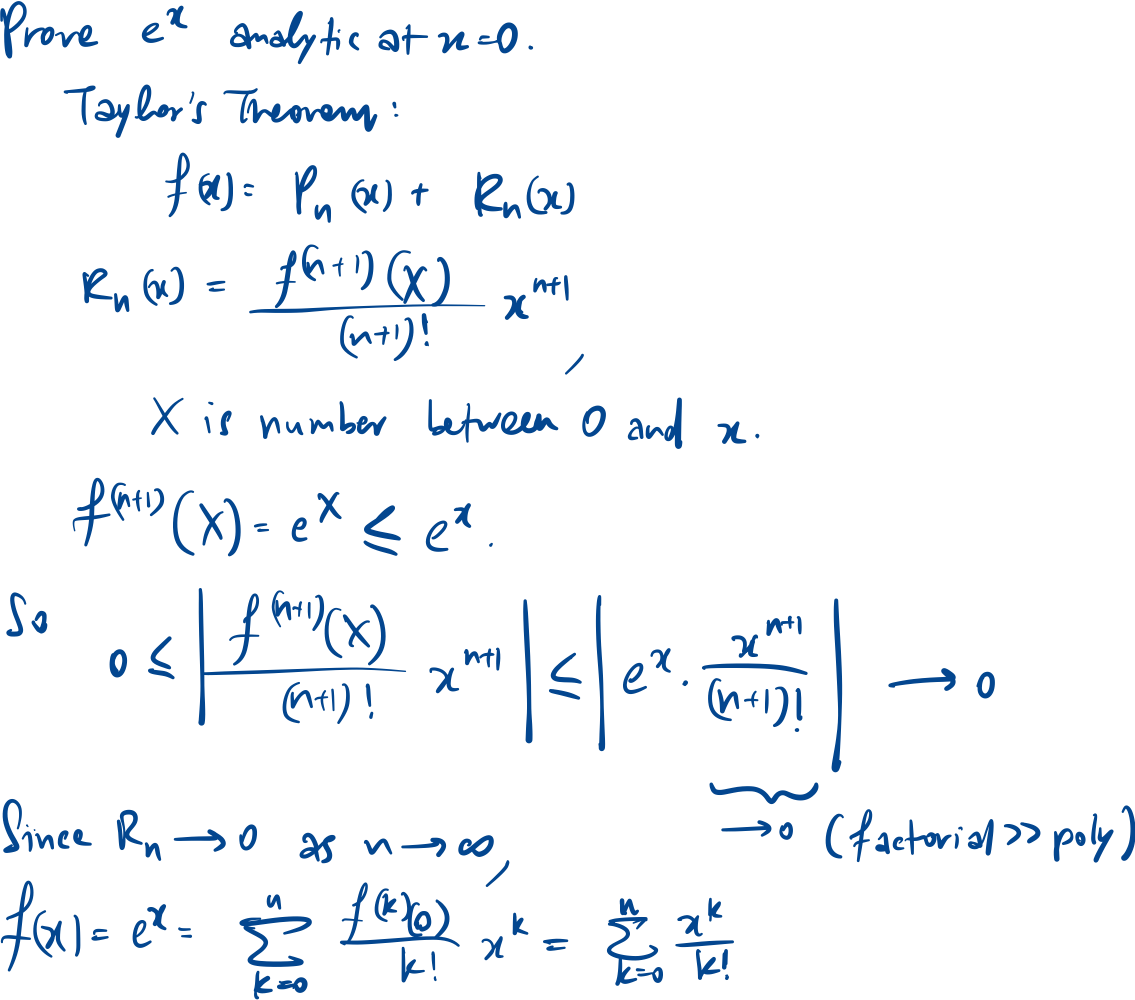
To show some function is analytic at x=0, express f = Pn + Rn, then show Rn → 0.

Useful equation: limn→∞xnn!=0\text{Useful equation: }\lim_{n \to \infty} \frac{x^n}{n!} = 0

Example

Ordo notation

Used when asked to find limit of some function by breaking down each special term into the first few terms of its Maclaurin expansion.

Definition

f=𝒪(g) as x→c, if ∃D,δ>0 such that |f|≤D|g|,∀x∈(c−δ,c+δ).f = \mathcal{O}(g) \text{ as } x \to c, \text{ if } \exists\, D, \delta > 0 \text{ such that } |f| \le D|g|, \ \forall\, x \in (c - \delta,\, c + \delta).

Properties

For 0≤m≤n,𝒪(xm)+𝒪(xn)=𝒪(xm), as x→0\text{For } 0 \le m \le n,\ \mathcal{O}(x^m) + \mathcal{O}(x^n) = \mathcal{O}(x^m), \text{ as } x \to 0

𝒪(g1)⋅𝒪(g2)=𝒪(g1g2) as x→c.\mathcal{O}(g_1) \cdot \mathcal{O}(g_2) = \mathcal{O}(g_1 g_2) \text{ as } x \to c.

𝒪(g1)g2=𝒪(g1g2) as x→c.\frac{\mathcal{O}(g_1)}{g_2} = \mathcal{O}\!\left(\frac{g_1}{g_2}\right) \text{ as } x \to c.

*Try to make the largest power the same on numerator & denominator.

Useful equations

(a+b+c)2=a2+b2+c2+2ab+2bc+2ca(a + b + c)^2 = a^2 + b^2 + c^2 + 2ab + 2bc + 2ca

(x+𝒪(x2))4=x4(1+𝒪(x))(x + \mathcal{O}(x^2))^4 = x^4(1 + \mathcal{O}(x))

Taylor’s theorem, asymptotic version f (n+1) c

and f(n+1) is continuous at c,\text{and } f^{(n+1)} \text{ is continuous at } c,

then f(x)=∑k=0nf(k)(c)k!(x−c)k+𝒪((x−c)n+1), as x→c.\text{then } f(x) = \sum_{k=0}^{n} \frac{f^{(k)}(c)}{k!}(x - c)^k + \mathcal{O}\!\left((x - c)^{n+1}\right), \text{ as } x \to c.

**we can cut off a Taylor series after some term and approximate the error.

ex≈1+x+x22+𝒪(x3).e^x \approx 1 + x + \frac{x^2}{2} + \mathcal{O}(x^3).

|error|≤Cx3 for x∈(−δ,δ), for some C,δ>0.\lvert \text{error} \rvert \le C x^3 \text{ for } x \in (-\delta,\delta), \text{ for some } C,\delta > 0.