For a binary relation R from A to B,R⊆A×B.\text{For a binary relation } R \text{ from } A \text{ to } B, \ R \subseteq A \times B.

Given (x,y) in A×B,xRy↔(x,y)∈R.\text{Given } (x, y) \text{ in } A \times B, xRy \leftrightarrow (x, y) \in R.

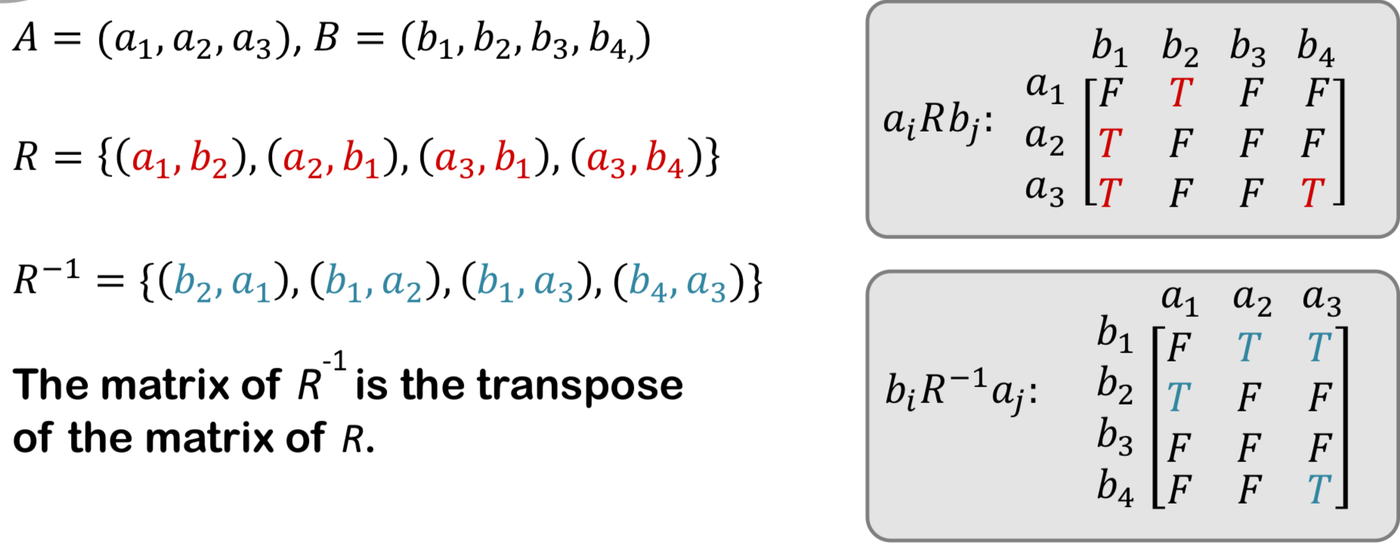
R−1={(y,x)∈B×A|(x,y)∈R}.R^{-1} = \{(y, x) \in B \times A \ | \ (x, y) \in R\}.

Matrix representation
Number of relations

Number of relations R on set=2n2.\text{Number of relations R on set} = 2^{n^{2}}.

Number of possible reflexive relations=2n2−n.\text{Number of possible reflexive relations} = 2^{n^{2} - n}.

Number of possible symmetric relations=2n⋅2(n2)=2n⋅2n(n−1)2=2n(n+1)2.\text{Number of possible symmetric relations} = 2^{n} \cdot 2^{\binom{n}{2}} = 2^{n} \cdot 2^{\frac{n(n - 1)}{2}} = 2^{\frac{n(n + 1)}{2}}.

Number of possible antisymmetric relations =2n⋅3(n2).\text{Number of possible antisymmetric relations } = 2^{n} \cdot 3^{\binom{n}{2}}.

Composition

For R in A×B, and S in B×C,the composition of R and S is a relation on A×C.\text{For } R \text{ in } A \times B, \text{ and } S \text{ in } B \times C, \text{the composition of R and S is a relation on } A \times C.

S∘R={(a,c)∈A×C|∃b∈B s.t. aRb and bSc.}S \circ R = \{(a, c) \in A \times C \ | \ \exists b \in B \text{ s.t. } aRb \text{ and } bSc.\}

R2=R∘RR^{2} = R \circ R

R2=R if R is reflexive and transitive.R^{2} = R \text{ if } R \text{ is reflexive and transitive.}

Properties of relations

Equivalence relation

  1. Reflexive
  2. Symmetric
  3. Transitive

E.g. xRy ⇔ (x-y) is even.

Equivalence class of a∈A:[a]={x∈A|aRx}\text{Equivalence class of }a \in A: [a] = \{x \in A | aRx\}

Equivalence classes form a partition of A.

For any a,b∈S, either [a]=[b] or [a]∩[b]=⌀, provable by contradiction.\text{For any } a, b \in S, \text{ either } [a] = [b] \text{ or } [a] \cap [b] = \varnothing, \text{ provable by contradiction.}

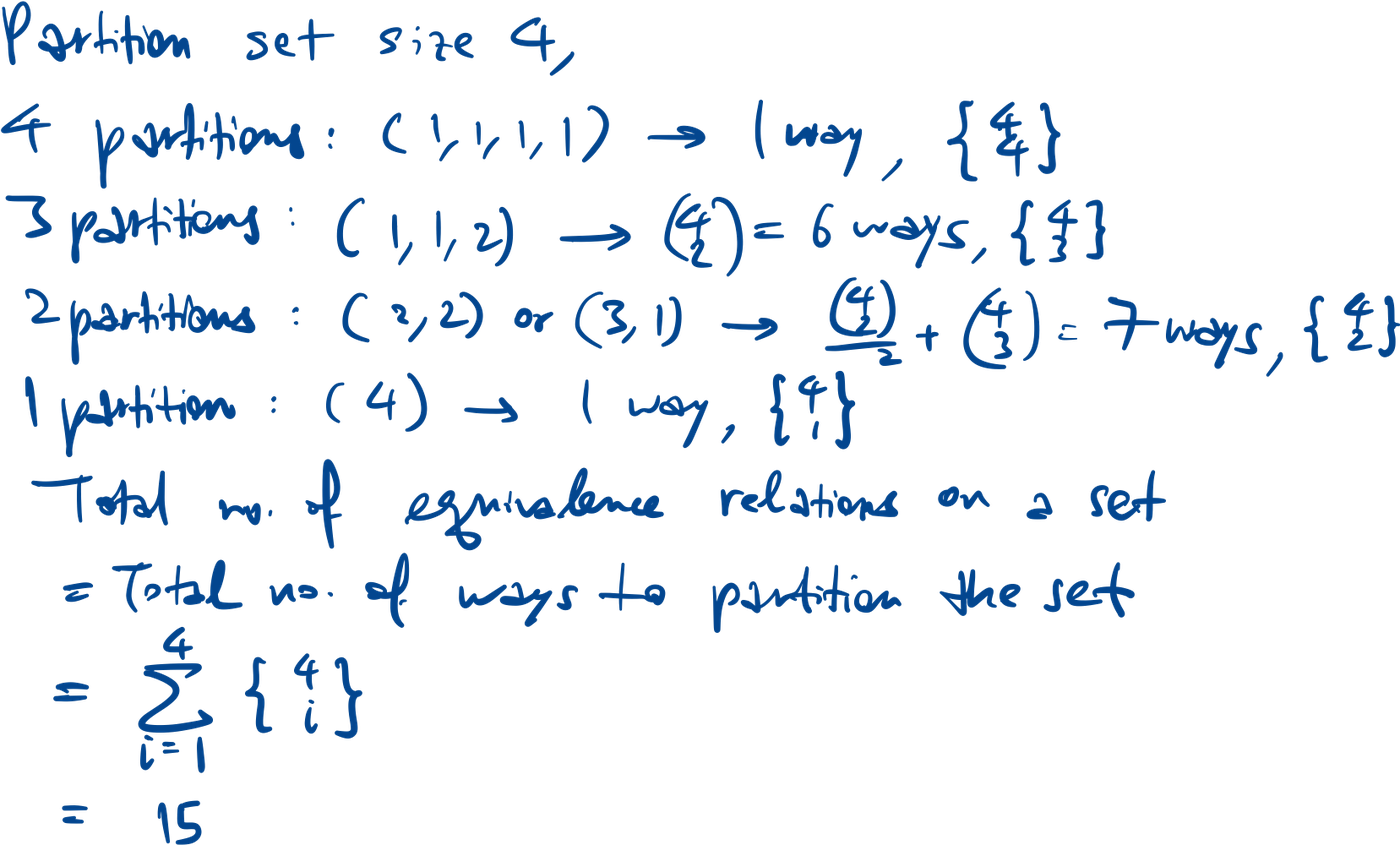
Number of equivalence classes on a set is the number of ways to partition the set.

Bell number, B:B1=1,B2=2,B3=5,B4=15,B5=52.\text{Bell number, }B: B_1 = 1, B_2 = 2, B_3 = 5, B_4 = 15, B_5 = 52.

Example for set of size 4

Partial order

  1. Reflexive
  2. Antisymmetric
  3. Transitive

Transitive closure

For transitive closure Rt,

  1. Rt is transitive
  2. R ⊆ Rt
  3. Rt ⊆ S, if S is any other transitive relation that contains R.
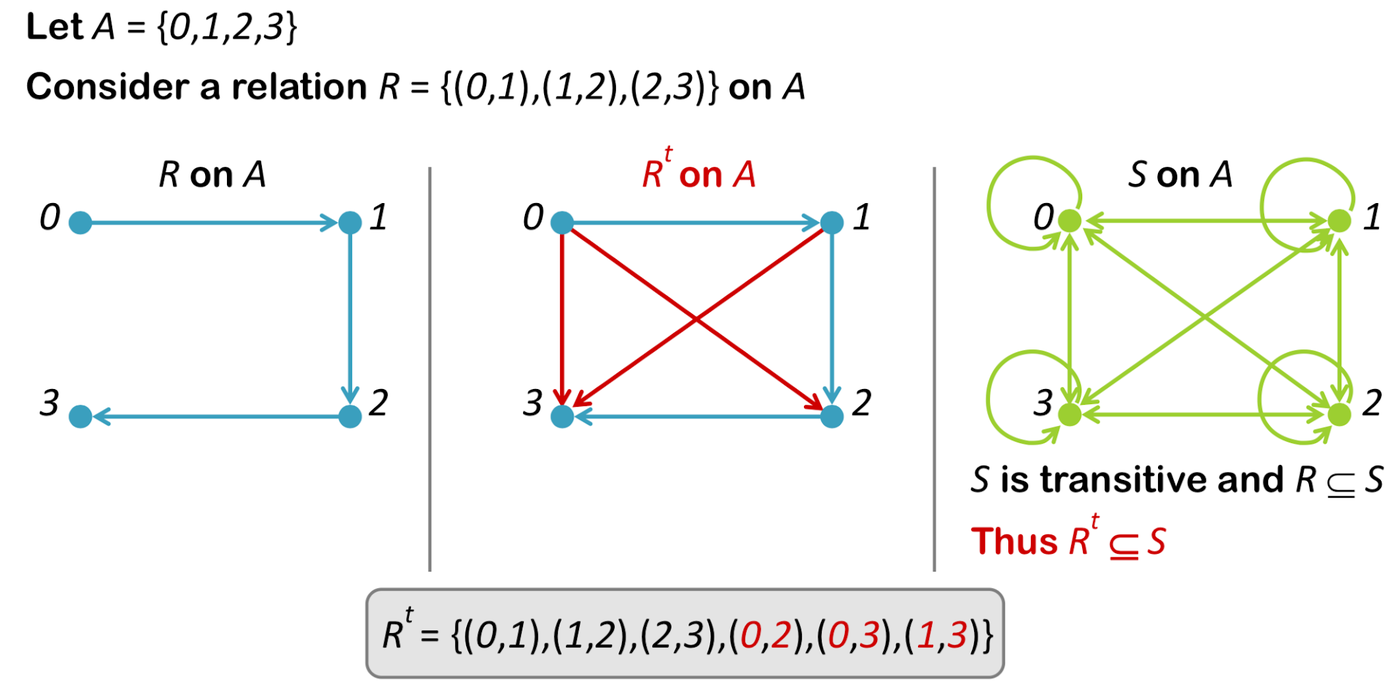
To get the transitive closure, add (x,z) if ∀x,y,z∈A,xRy∧yRz for R on set A.\text{To get the transitive closure, add }(x,z) \text{ if } \forall x, y, z \in A, xRy \land yRz \text{ for } R \text{ on set } A.

Rt=R∪R2∪R3∪…R^{t} = R \cup R^{2} \cup R^{3} \cup \ldots

Generalise n-ary relation R⊆A1×…×An.(a1,…,an)∈R→a1,…,an are related.\text{Generalise n-ary relation }R \subseteq A_1 \times \ldots \times A_n. \ (a_1, \ldots, a_n) \in R \rightarrow a_1, \ldots, a_n \text{ are related.}

Relational complement

R¯=(A1×A2×…×An−R)\overline{R} = (A_1 \times A_2 \times \ldots \times A_n - R)

(a1,a2,…,an)∈R¯↔(a1,a2,…,an)∉R.(a_1, a_2, \ldots, a_n) \in \overline{R} \leftrightarrow (a_1, a_2, \ldots, a_n) \notin R.

Operations on relations

R∪S:(a1,a2,…,an)∈R∪S↔(a1,a2,…,an)∈R∨(a1,a2,…,an)∈S.R \cup S: (a_1, a_2, \ldots, a_n) \in R \cup S \leftrightarrow (a_1, a_2, \ldots, a_n) \in R \lor (a_1, a_2, \ldots, a_n) \in S.

R∩S:(a1,a2,…,an)∈R∪S↔(a1,a2,…,an)∈R∧(a1,a2,…,an)∈S.R \cap S: (a_1, a_2, \ldots, a_n) \in R \cup S \leftrightarrow (a_1, a_2, \ldots, a_n) \in R \land (a_1, a_2, \ldots, a_n) \in S.