A function assigns every element in its domain to one and only one element in its codomain.

f:X⇒Y,(∀x∈X,∃y∈Y,y=f(x))∧(∀x1,x2∈X,f(x1)≠f(x2)→x1≠x2)f: X \Rightarrow Y, (\forall x \in X, \exists y \in Y, y = f(x)) \land (\forall x_1, x_2 \in X, f(x_1) \neq f(x_2) \to x_1 \neq x_2)

Range of a function is a subset of the codomain, containing all the images.

Injective

For f:A→B,|A|=m,|B|=n with n>=m, how many injective functions f are there?\text{For } f: A \rightarrow B, \ |A| = m, \ |B| = n \text{ with } n >= m, \text{ how many injective functions } f \text{ are there?}

n(n−1)(n−2)...(n−m+1)=nPmn(n-1)(n-2)...(n-m+1) = nPm

Surjective

Surjective/onto function f:X→Y,∀y∈Y∃x∈X,f(x)=y\text{Surjective/onto function }f: X \rightarrow Y, \forall y \in Y \ \exists x \in X, f(x) = y

For surjective f:X→Y,|X|≥|Y|\text{For surjective }f: X \rightarrow Y, \ |X| \geq |Y|

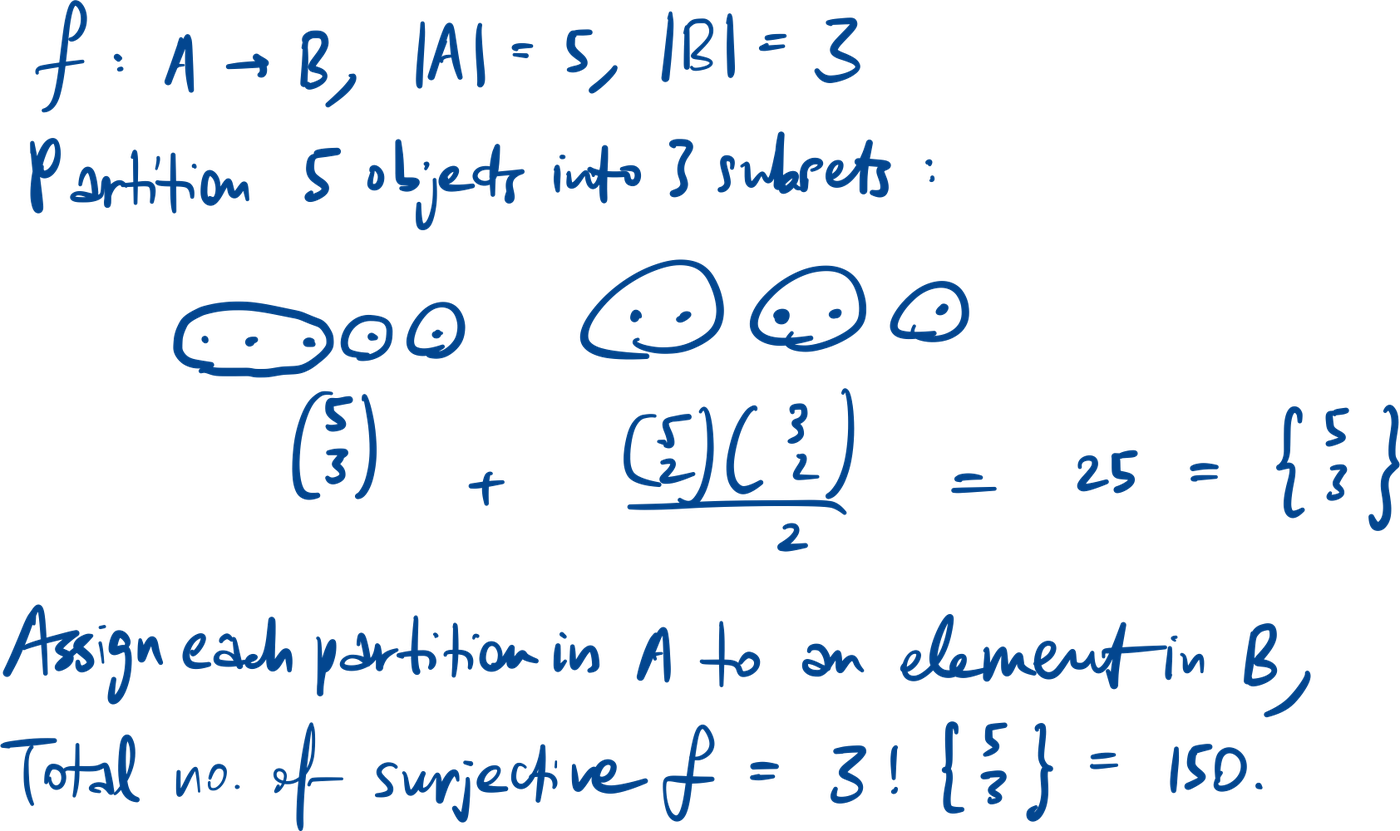
For f:A→B,|A|=m,|B|=n,m≥n, how many surjective functions f are there?\text{For } f: A \rightarrow B, \ |A| = m, \ |B| = n, \ m \geq n, \text{ how many surjective functions } f \text{ are there?}

n!{mn}n! \, \left\{ \begin{matrix} m \\ n \end{matrix} \right\}

{mn}\, \left\{ \begin{matrix} m \\ n \end{matrix} \right\}is the number of ways to partition a set of m objects into n non-empty subsets (Stirling number).
Bijective

Bijective / one-to-one correspondence function f is both injective and surjective.\text{Bijective / one-to-one correspondence function }f \text{ is both injective and surjective.}

Bijective f:X→Y,|X|=|Y|\text{Bijective }f: X \rightarrow Y, \ |X| = |Y|

For f:A→B,|A|=m,|B|=n,m=n, how many bijective functions f are there?\text{For }f: A \rightarrow B, \ |A| = m, \ |B| = n, \ m=n, \text{ how many bijective functions }f \text{ are there?}

n(n−1)(n−2)...(1)=n!n(n-1)(n-2)...(1) = n!

Identity function

On a set A, iA:A→A,iA(x)=x.\text{On a set A, } i_A: A \rightarrow A, i_A(x) = x.

Inverse function

For f−1 to be defined, f has to be bijective.\text{For }f^{-1} \text{ to be defined, }f \text{ has to be bijective.}

For f:X→Y,f−1:Y→X,∀x∈X,∀y∈Y,f(x)=y⇔f−1(y)=x.\text{For }f: X \rightarrow Y, \ f^{-1}: Y \rightarrow X, \ \forall x \in X, \ \forall y \in Y, \ f(x) = y \iff f^{-1}(y) = x.

If f bijective, then f−1 bijective.\text{If }f \text{ bijective, then } f^{-1} \text{ bijective.}

Composite function

g∘f:X→Z:(g∘f)(a)=g(f(a)), where f:X→Y and g:Y→Z.g \circ f: X \rightarrow Z: (g \circ f)(a) = g(f(a)), \text{ where } f: X \rightarrow Y \text{ and } g: Y \rightarrow Z.

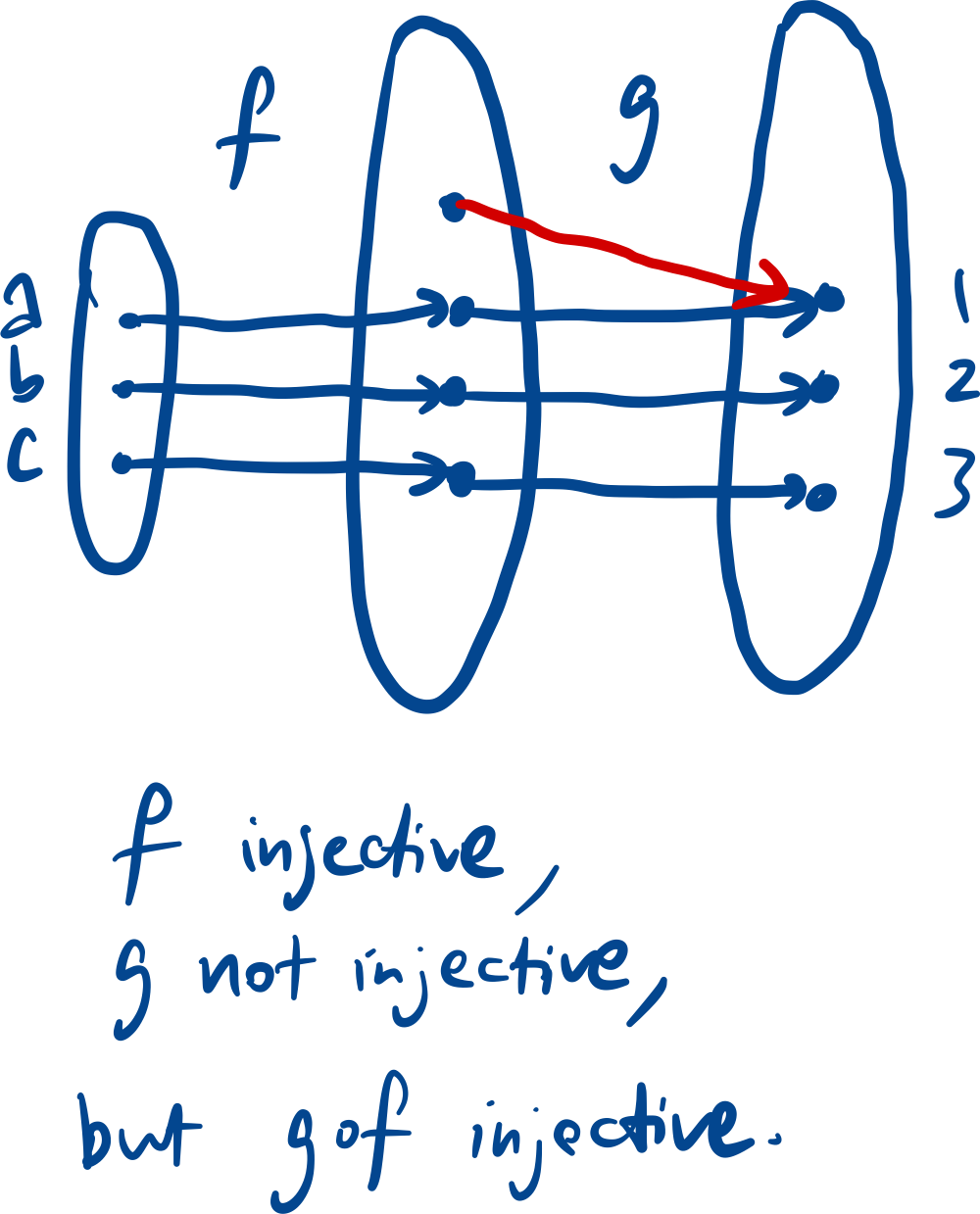
If f,g injective, then g∘f is injective.\text{If } f, g \text{ injective, then } g \circ f \text{ is injective.}

But if g∘f injective, g need not be injective. g needs to be injective only on the range of f.\text{But if } g \circ f \text{ injective, } g \text{ need not be injective. } g \text{ needs to be injective only on the range of } f.

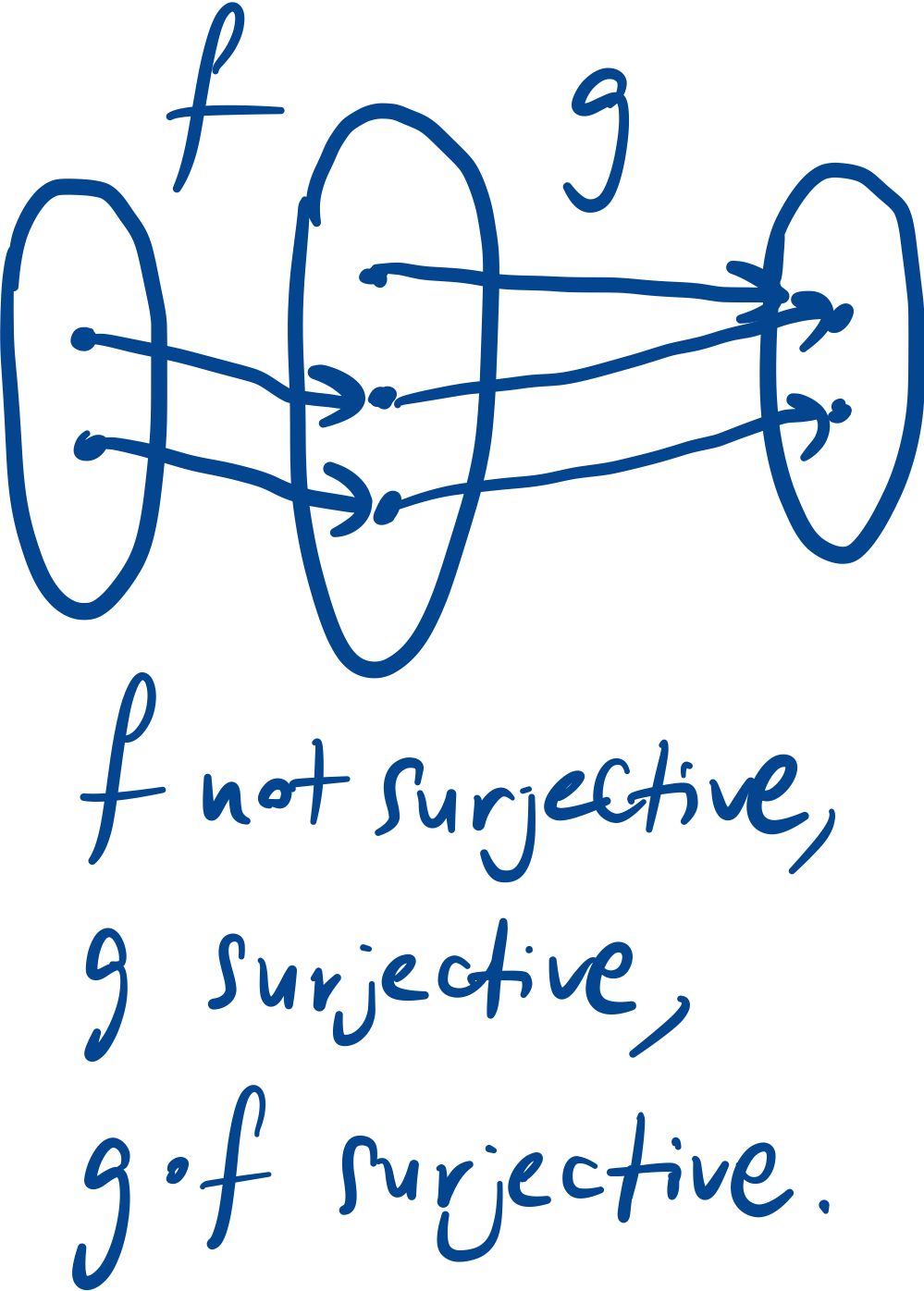
If f,g surjective, then g∘f is surjective.\text{If } f, g \text{ surjective, then } g \circ f \text{ is surjective.}

But if g∘f is surjective, f need not be surjective.\text{But if } g \circ f \text{ is surjective, }f \text{ need not be surjective.}

Range of f just needs to cover enough of domain of g, to map onto range of g.\text{Range of } f \text{ just needs to cover enough of domain of } g, \text{ to map onto range of } g.

Special functions

Floor, ceiling functions

⌈−π⌉=−3\lceil -\pi \rceil = -3

⌊−π⌋=−4\lfloor -\pi \rfloor = -4

Number of integers from 1000 to 2023 inclusive which are divisible by 6=⌊20236⌋−⌊9996⌋\text{Number of integers from 1000 to 2023 inclusive which are divisible by 6} = \lfloor \frac{2023}{6} \rfloor - \lfloor \frac{999}{6} \rfloor

Pigeonhole principle

For n items placed into k containers, n≥k,\text{ For n items placed into k containers, } n \ge k \;,

then at least one container must contain≥⌈nk⌉items.\text{then at least one container must contain} \ge \left\lceil \frac{n}{k} \right\rceil \text{items.}

Mapping one finite set to a smaller finite set cannot be an injective function.

Example question

In a party of 6 people, prove that there exists at least 3 people who are all friends or all strangers.

Take some person A, he can be friends/strangers with 5 other people (B, C, D, E, F). By pigeonhole principle, there are at least ⌈52⌉=3\left\lceil \frac{5}{2} \right\rceil = 3 people with whom he has the same relationship with. WLOG, suppose A is friends with B,C,D. Then look at the relationships between B, C, D. If any 2 of them are friends, suppose B & C are friends, then A, B, C form the 3 people who are friends with each other. If none of B, C, D are friends with each other, then we have the 3 people who are strangers with each other.

Countability
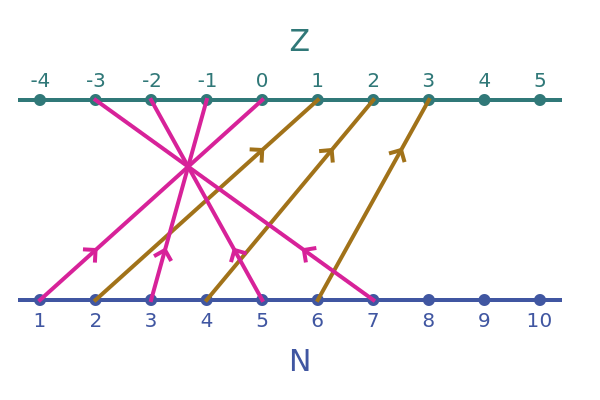
A set is countable if a bijection can be formed from ℕ to that set.\text{A set is countable if a bijection can be formed from } \mathbb{N} \text{ to that set.}

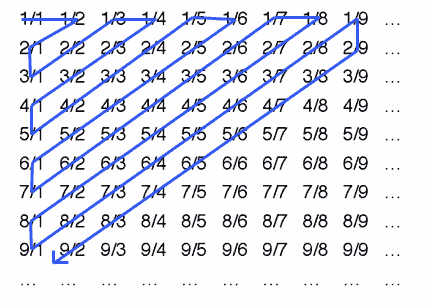
ℤ,ℚ,algebraic numbers are countable.\mathbb{Z}, \ \mathbb{Q}, \ \text{algebraic numbers are countable.}

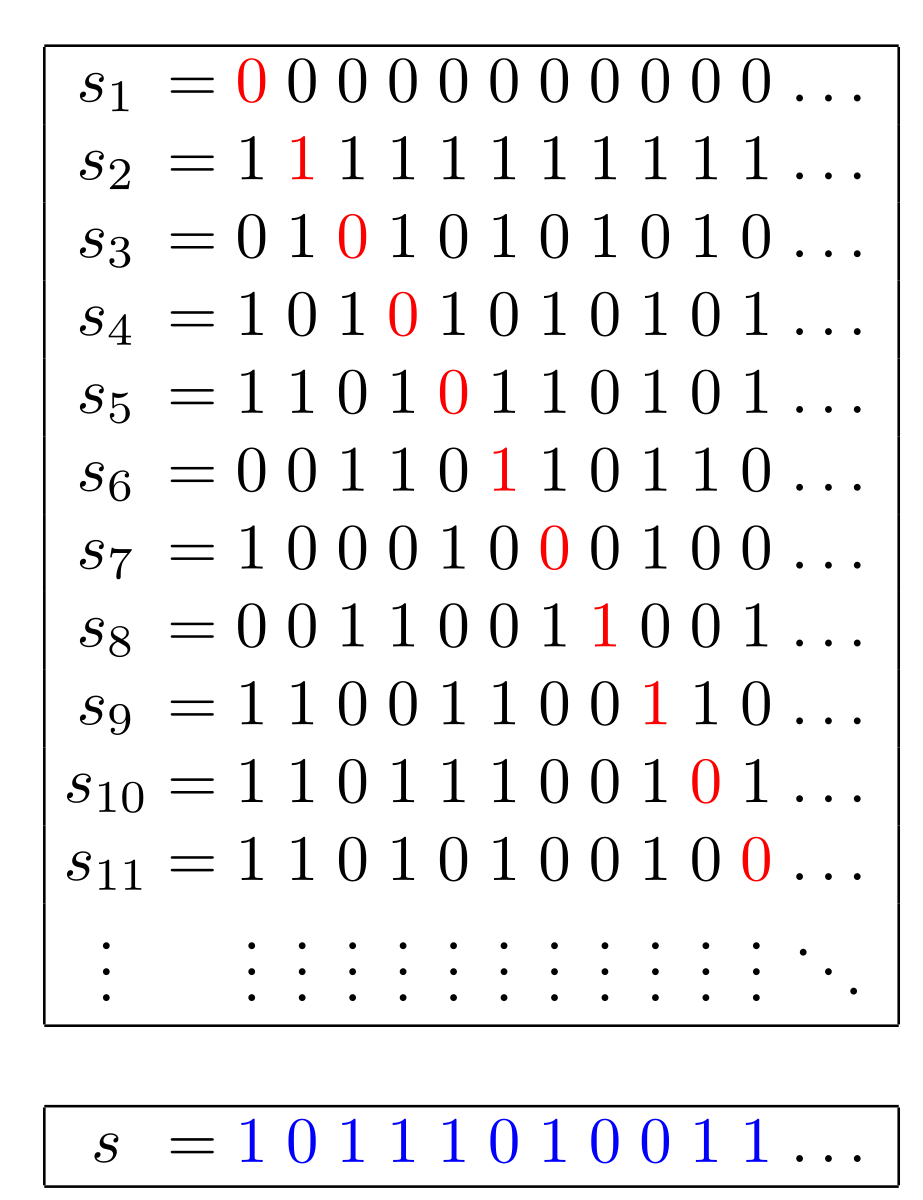
ℝis uncountable.\mathbb{R} \ \text{is uncountable.}

f(x)={n2if x even−n+12if x odd f(x) = \begin{cases}\frac{n}{2} & \text{if } x \text{ even} \\ - \frac{n + 1}{2} & \text{if } x \text{ odd }\end{cases}