Data Transfer Mechanisms
| Mechanism | Controller / Nature | Latency | CPU Eff. | Transfer Rate / Modes | Debugging |
|---|---|---|---|---|---|
| Polling | CPU SW-driven active check. |
Very Fast 1–3 cycles. |
Very Low 100% blocked. |
Low CPU fetches per byte. |
Easy Deterministic. |
| Interrupt | CPU HW trigger, SW exec. |
Slower Context switch. |
High Free until signaled. |
Moderate CPU still moves data. |
Difficult Asynchronous. |
| DMA | DMAC Pure HW controller. |
Moderate Bus arbitration. |
Very High CPU fully freed. |
Maximum Burst, Steal, Transparent. |
Moderate Silent RAM alters. |
Data transfer can be initiated by the CPU or the DMAC.
Polling (Programmed I/O)
CPU polls a certain I/O port continuously (using software) for data
or readiness of the port to perform a data transaction.
CPU uses 100% of its resource to do the polling. It cannot entertain any
other requests.
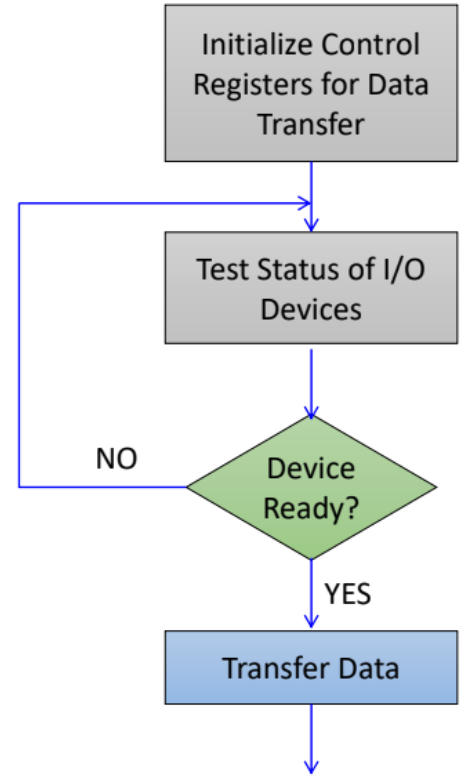
Programmer has complete control over the process, easier to test and debug.
Program execution of CPU held up while waiting for I/O device to get ready, inefficient use of CPU resources.
Interrupt Triggered
Uses hardware: A signal from external/internal peripheral, or a change in status of some special registers notifies the CPU that some event has occur.
If the CPU decide to service the interrupt, it will suspend its current program temporarily.
The interrupt will come with some interrupt vector table (IVT) index.
CPU look up the IVT to check the starting address of the interrupt service routine (ISR) for the corresponding interrupt.
CPU then proceed to execute the ISR linked to the interrupt that was triggered (typically a short routine).
Once the ISR is completed, CPU restore the saved context, returns to the interrupted routine and continue from where it had left previously.
Interrupt latency: delay bw CPU receiving the interrupt req, and the pt of entering the ISR.
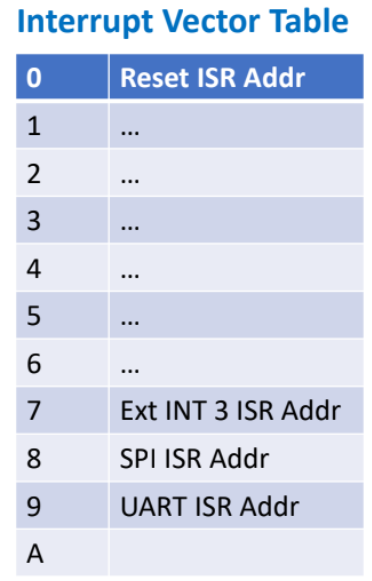
CPU does not need to monitor I/O device status, more efficient use of CPU resources.
But more hardware interface circuitry required between I/O device and processor. Program is slightly more complex and difficult to debug.
Direct Memory Access (DMA)
DMAC is a Data Bus Controller module that performs data transfer independent of CPU.
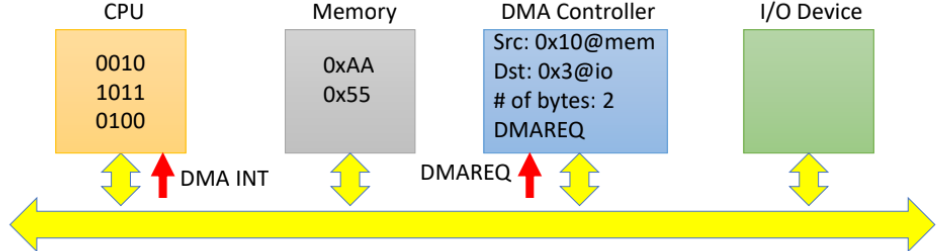
CPU configures some parameters for DMAC to trf data
Src and Dest addr of data
No. of bytes to trf
Trigger signal telling DMAC when to start the trf.
DMAC waits till trigger signal comes in.
It requests for system bus and start data trf. (Data goes into internal buffer of DMAC before transferred to dest)
After trf, DMAC releases the system bus, notifies CPU of data completion via interrupt.
3 modes of transfer:
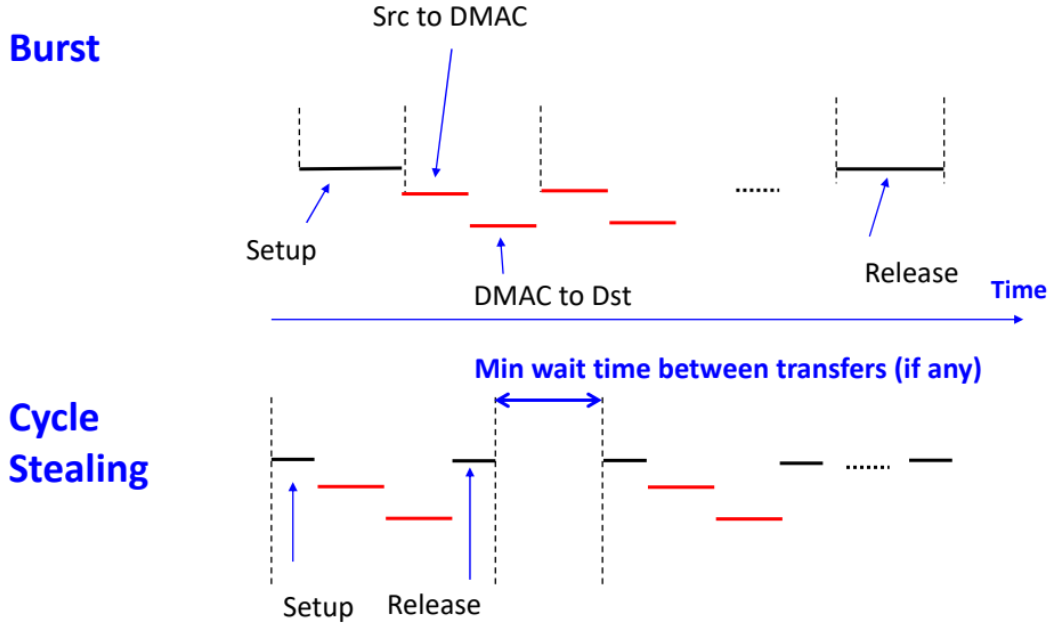
Burst: During control of the system bus, DMAC trf multiple units of data.
Could be entire block of data that DMAC tasked to trf, or just a subset of that block.
CPU can continue with its operation as long it does not need the particular system bus that DMAC is using.
So Burst has faster trf rate but CPU may be suspended/inactive if CPU has to wait for DMAC to complete its trf.
Cycle stealing: DMAC trfs one unit of data aft taking control, then releases control of system bus to CPU.
DMAC can execute the data trf between CPU instructions or between pipeline stages.
CPU may be suspended if it need to access the system bus but suspend time is shorter as only one unit is transferred at one time.
Transfer rate is slower than in Burst Mode but will CPU will only be inactive for very short period of time.
Favoured if CPU needs to be responsive.
Transparent: DMAC trfs data only when CPU not using the system bus.
CPU performance not affected, but potentially slowest trf rate.
More complex hardware needed to detect when CPU not using the system bus.
So from burst to cycle-stealing to transparent, data trf gets slower but CPU performance/response improves.
Transferring via CPU can be faster than DMA as CPU speed is typically faster, just that it means wasting CPU resources to just transfer data.