10 A* Search
Minimises both path cost so far and estimated cost to goal,
10.0.0.1 Admissible heuristics
A heuristic function is admissible (optimistic) if it never overestimates the true cost to the goal. where is the true lowest cost to from to the goal.
10.0.0.2 Theorem
If
is admissible, A* is guaranteed to find an optimal path to the
goal.
Because A* never overestimates, A* never ignores a shorter path in
favour of a longer one. So when A* reaches the goal for the first time,
it is guaranteed to be the optimal one.
10.0.0.3 Example
2D grid: Manhatten distance (for strictly vertical and horizontal
movements)
where
is coordinate of state
and
is coordinate of goal state.
The actual steps needed is at least equal to the number of horizontal
steps + vertical steps.
10.0.0.4 Example
Unrestricted movement in 2D space: Euclidean distance
10.0.0.5 Example
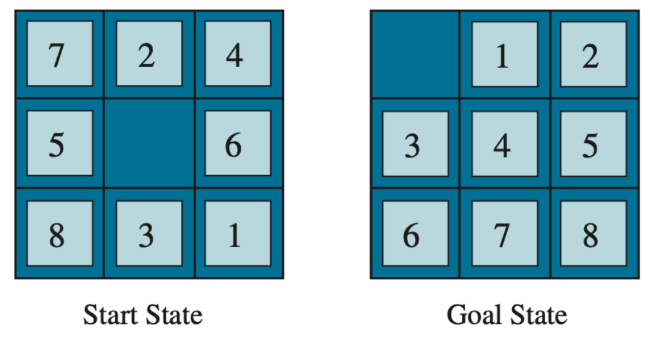
8-puzzle