8 Uniform Cost Search
function UCS(P = ⟨S, s₀, A, τ, c, G⟩):
    g(s) ← ∞  for all s ∈ S
    agenda ← {s₀}                     # agenda is a set
    while agenda ≠ ∅:
        C ← arg min_{s ∈ agenda} g(s)
        s' ← any element of C
        if s' ∈ G:                    # goal found?
            return "done"
        for a ∈ A:                    # expand s
            s'' ← τ(s', a)
            update g(s'')  (replace existing value if smaller)
            agenda ← agenda ∪ {s''}
We have the cost function
UCS involves keeping cost of the path to any node. Let this be .
UCS utilises a priority queue, where the priority is the path cost.
UCS expands cheapest nodes first (in order of incerasing path cost).
Always finds optimal path if costs are non-negative ( path costs either stay the same or increase). If UCS found the goal with cost , there can’t be another path with cost , since UCS would already have expanded the path, by definition of the priority queue.
UCS becomes BFS when all step costs are equal.
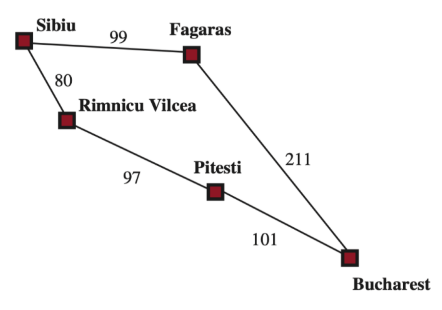
Execution Example
Successors are Rimnicu (80) and Fagaras (99)
Rimnicu is selected for expansion
Successor is Pitesi ()
Least cost is now Fagaras
Successor is Bucharest ()
Pitesi now selected for expansion
Bucharest updated ()
Bucharest selected for expansion; goal reached with optimal path