7 segment decoder
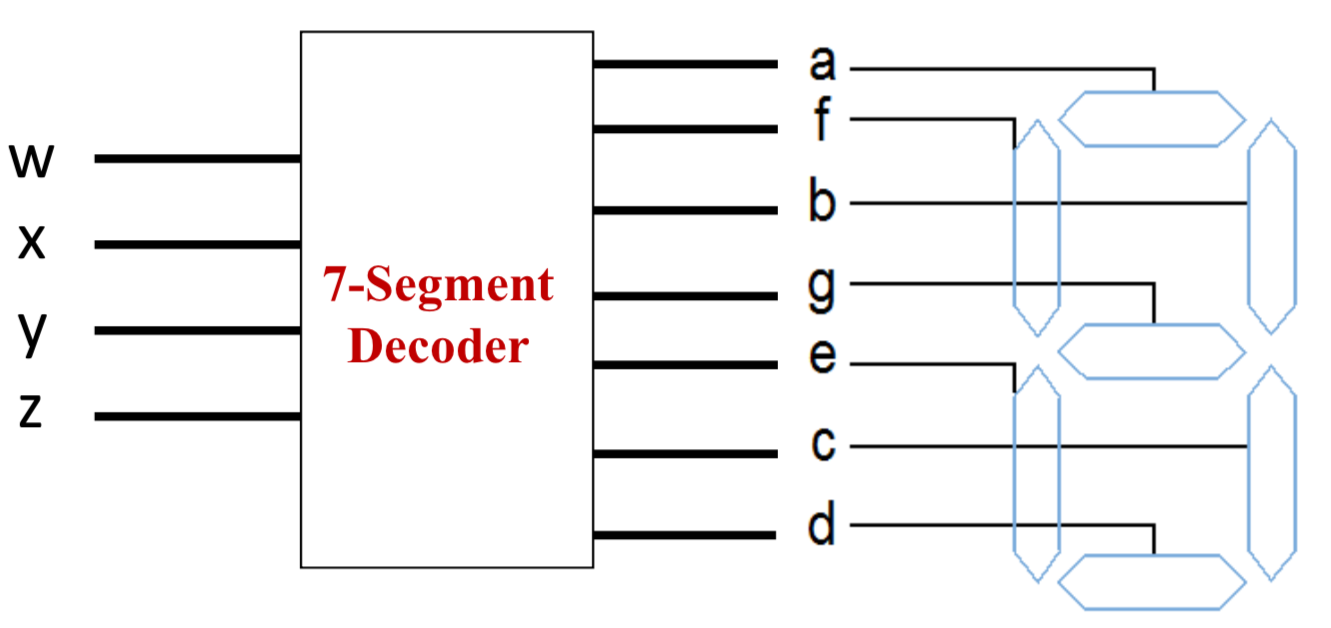
Separately determine equation and circuit for each segment, a,b,…,g, depending on hex value input.
Decoder
One-hot output based on binary input, output width = 2N for N-bit input
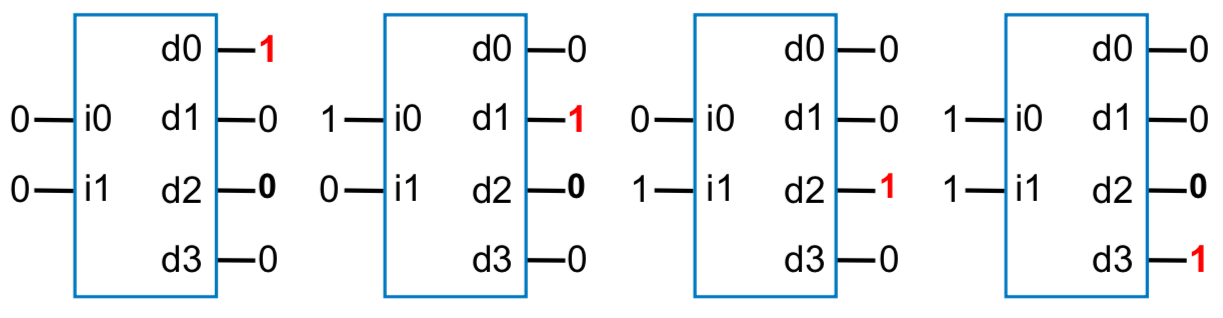
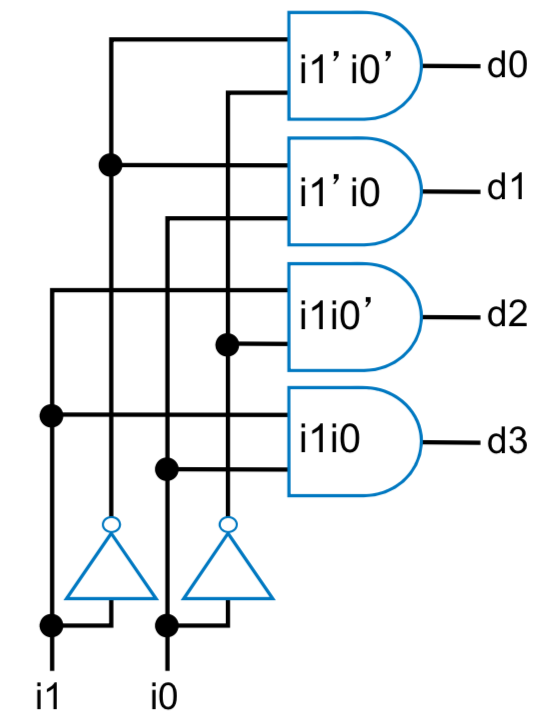
module decoder (input [1:0] in,
            output reg [3:0] out);
  always @ * begin
    case (in)
      2'b00: out = 4'b0001;
      2'b01: out = 4'b0010;
      2'b10: out = 4'b0100;
      2'b11: out = 4'b1000;
      default: out = 4'b0000;
    endcase
  end
endmodule
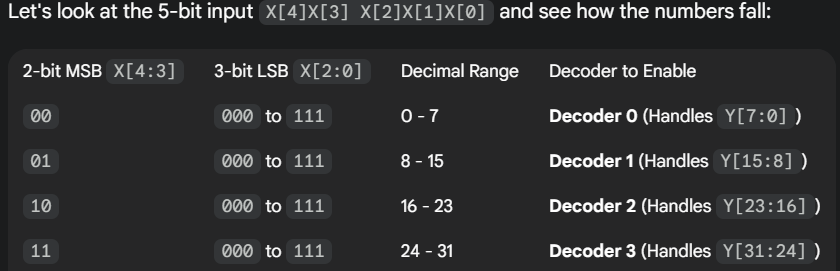
**Implement 5x32 decoder using one 2x4 decoder and four 3x8 decoders.
Input [4:0] X, output [31:0] Y
wire [3:0] enable
2x4decoder(.input(X[4:3)], .output(enable))
3x8decoder(.input(en[0]), .input(X[2:0]), .output(Y[7:0]));
3x8decoder(.input(en[1]), .input(X[2:0]), .output(Y[8:15]));
3x8decoder(.input(en[2]), .input(X[2:0]), .output(Y[16:23]));
3x8decoder(.input(en[3]), .input(X[2:0]), .output(Y[24:31]));
Reason:
Split into 4 cases, based on the first two MSB of X, then enable the corresponding decoder.
Multiplexer
The select input (sel) determines which input connects to the output.
N-input mux thus requires log2(N)-bit select input.
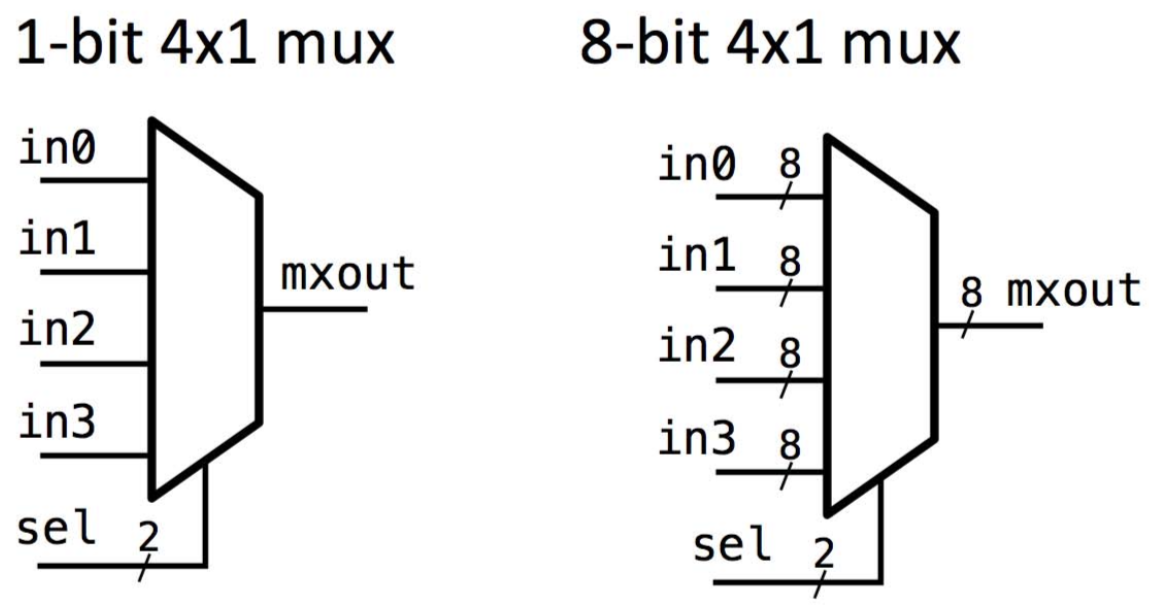
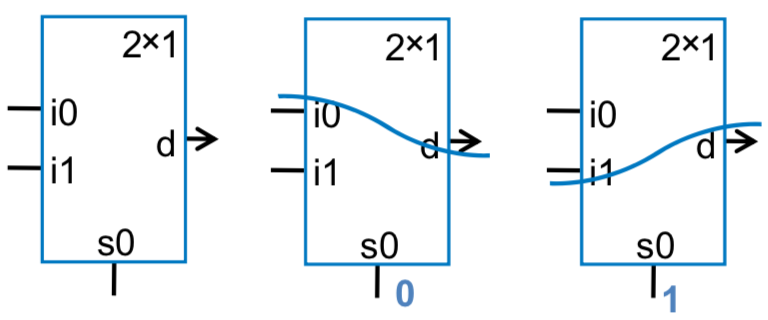
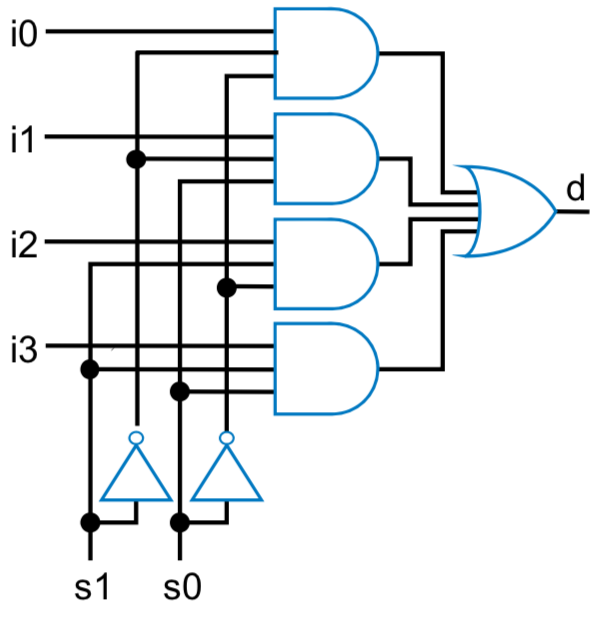
Implementation of mux using decoder
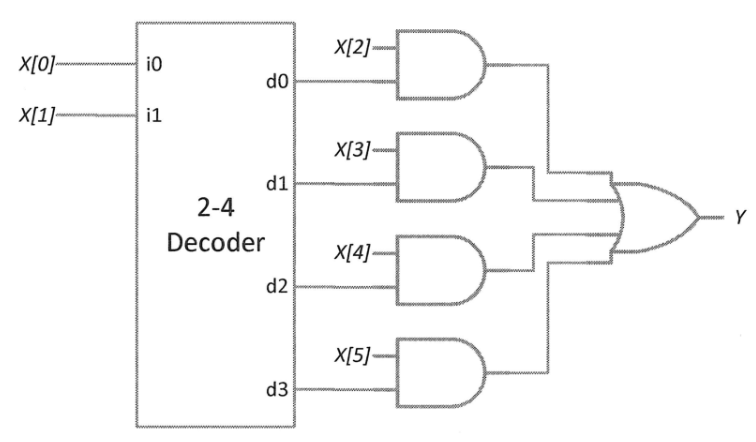
module mux (input [3:0] in,
              input [1:0] sel,
              output reg mxout);
  always @ * begin
    case (sel)
      2'b00: mxout = in[0];
      2'b01: mxout = in[1];
      2'b10: mxout = in[2];
      2'b11: mxout = in[3];
      default: mxout = in[0];
    endcase
  end
endmodule